

The teams that outperform don’t make fewer mistakes. They discover problems earlier, before the cost of fixing them compounds.
The pattern holds wherever people build for other people: the earlier a need becomes visible, the more effectively you can respond to it. The challenge isn’t competence. It’s building environments where people can see what’s actually happening.
In an era when AI is compressing product development cycles faster than any shift since the internet, the ability to find the right problem has become the highest-value skill. Organizations can build anything. The ones that outperform know what to build. And they build the methods and culture that keep working after the people who started them move on.
In the mid-1990s, Harvard researcher Amy Edmondson set out to study teamwork and medication errors in hospital nursing units. Her hypothesis was straightforward: the units with the strongest teamwork would make fewer mistakes. Fewer wrong doses, fewer missed administrations, fewer patients put at risk.
When the data came back, it showed the opposite. The units with the best teamwork reported *more* medication errors than their peers.
Edmondson thought her research had failed. Then she looked closer.
The stronger teams weren’t making more mistakes. They were *finding* more of them. In those units, nurses talked openly about what went wrong and worked together to prevent recurrence. In the weaker units, nurses who discovered a mistake kept it to themselves. A nurse on one of those teams described feeling “like I was a two-year-old” when something went wrong. Another said, “You get put on trial.”
The difference wasn’t competence. It was environment. The stronger teams had built something harder to measure than error rates: trust. Not trust as an abstraction, but as a working condition — the specific, practical confidence that surfacing a problem wouldn’t cost you. That trust made it possible to see the gap between what patients needed and what they were actually getting, even when seeing that gap was uncomfortable.
Three decades later, her insight held under extreme conditions. In a 2024 study of over 27,000 healthcare workers, Edmondson and colleagues found that teams with psychological safety established before the COVID pandemic experienced less burnout and higher retention during it. The environments built in calm sustained people through crisis.

In Edmondson’s hospitals, the cost of a hidden medication error was patient harm. In product development, the cost of a hidden user need is rework, building something people don’t actually want, then fixing it after launch. The principle is the same. The question is whether it can work across 400,000 people.
My father was a systems engineer at IBM in the 1960s, the sock garters era, when the uniform was white shirts, dark suits, and wingtips. I didn't appreciate until much later that it was also a design-forward company. Thomas Watson Jr. had hired Eliot Noyes, an architect and former MoMA curator, as consulting director of design. Noyes brought in Paul Rand, who created the iconic eight-bar logo, and Charles and Ray Eames to produce landmark exhibitions. Watson’s conviction was simple and structural: “Good design is good business.” Not a slogan — a governing principle.
Over the following decades, IBM scaled into a $100 billion enterprise with nearly 400,000 employees across 170 countries, achieving significant advances in mainframes, servers, and cloud infrastructure. The engineering culture that powered that growth was itself an accomplishment.
In 2012, Phil Gilbert took on the challenge of revitalizing Watson’s founding conviction and giving it modern methods and mechanisms at the scale IBM had become.
The Bet
Gilbert, IBM’s General Manager of Design, put the tension bluntly: “A business doesn’t care about Design Thinking. A business only cares about market outcomes.”
His intention was specific: improve market outcomes by understanding customer needs before building. Design culture and empathy mattered, but Gilbert anchored the effort in business language the organization could measure. What followed was built to serve that intention.
IBM went beyond training.
They built an operating system for need finding, with specific mechanisms designed to keep customer reality in the room where decisions get made.
Hills required teams to define outcomes in terms of what a specific user could accomplish: not features to ship, but needs to meet. Sponsor Users embedded real customers into product teams as persistent participants at key decision points. Playbacks created a regular cadence where cross-functional teams presented evidence of progress against user outcomes, alignment built on shared understanding rather than opinion.
The rigor mattered. Hills were specific, testable statements. Sponsor Users were people in the room reacting to real work. Playbacks were structured accountability to what teams had learned, not what they’d assumed. Precise tools built for a specific purpose, not generic methods borrowed from a playbook.

IBM scaled the practice across 50 studios and hundreds of product teams. Then they measured what happened.
The Compound Effect
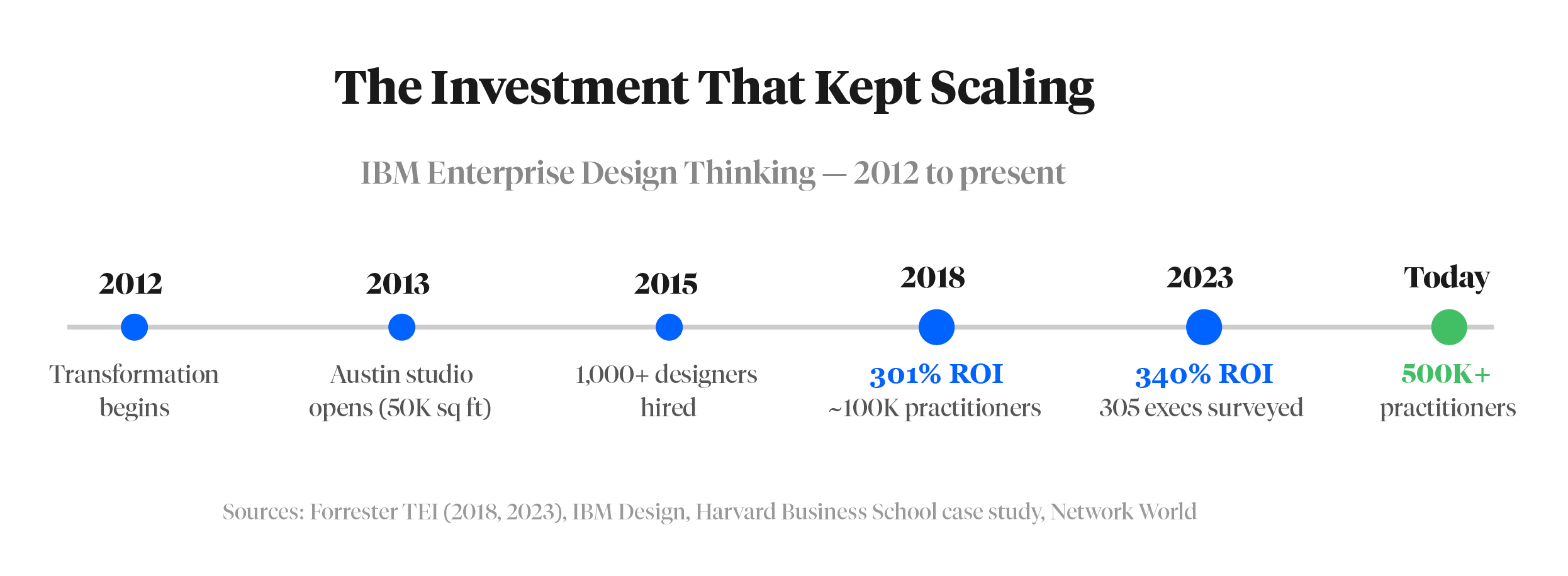
In 2018, Forrester studied Fortune 1000 companies engaging IBM’s design practice: 75% reduction in design and development time. Defects dropped by more than 50%. A 301% return on investment. Both studies were commissioned by IBM and modeled a composite client organization. Rigorous work, but readers should keep the sponsor in mind. The actual impact across IBM’s own portfolio of hundreds of products and millions of users is far larger than any single client study can capture.
Those returns were measured when build cycles lasted months. As AI compresses development timelines from months to weeks, the value of knowing what to build grows proportionally.
The value came from the same mechanism Edmondson observed — teams discovering problems earlier.
Defects caught in design rather than production saved roughly 100 developer hours each. Teams aligned through Playbacks moved faster. And teams working with Sponsor Users were doing what Edmondson calls intelligent failure in “Right Kind of Wrong” (2023): small, deliberate tests with real users that surface bad assumptions before the stakes get high.
Five years later, Forrester returned: 305 executives, seven in-depth interviews. The returns had grown. ROI: 340%. Payback in under six months. As of 2026, IBM reports over 500,000 practitioners trained in Enterprise Design Thinking, up from 100,000 when the first study was published.
McKinsey confirmed the pattern independently: design-led companies outperformed benchmarks by 32% in revenue growth and 56% in total shareholder returns. But only the top quartile captured those returns. The bottom three quartiles showed no significant difference from their peers. Scattered adoption doesn’t change how an organization operates.
Committed practice does.
Why It Lasted
What’s worth noting about IBM’s transformation isn’t the numbers. It’s the timeline.
2013: first studio opens. 2015: major hiring wave. 2018: 301% ROI. 2023: 340%. Today: half a million practitioners. Phil Gilbert eventually left IBM. The studios remained. The Hills and Playbacks remained. The systems made need finding the path of least resistance.
I saw this pattern at SoFi. When I joined as VP of Design and Research in 2019, the company was expanding quickly, from student loan refinancing into a full financial product suite designed to help members “get their money right.” Lending, investing, banking, credit cards, money management. Each product had its own team, its own roadmap, its own definition of success. The ambition was right, CEO Anthony Noto had a clear vision of a unified financial wellness platform. But the products lived in silos. The organizational structure was leaking through to the customer experience.
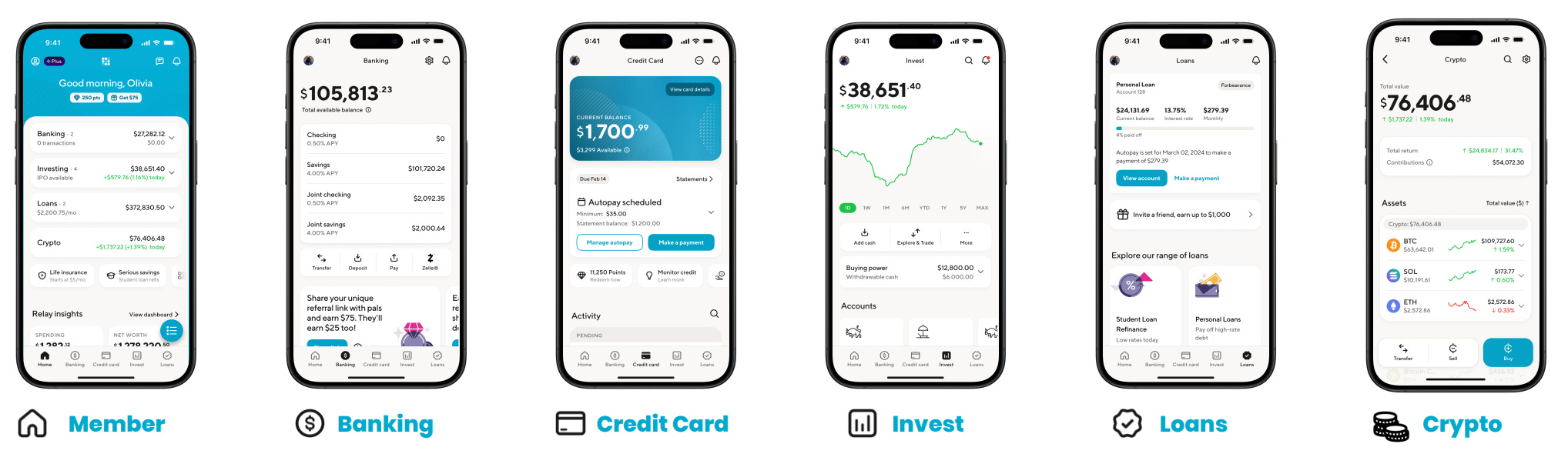
We started with need finding. Member segments built on jobs to be done. A personalized feed that recognized where members were in their financial journey. A unified design system, a shared language that let teams deliver coherent experiences without constant coordination.
The lending team had other priorities, so we didn’t force it. We ran experiments, built evidence, and let the data make the case. Trust wasn’t assumed. It was earned. When loans adopted the design system improvements, conversion rose 30%.
Between 2019 and SoFi’s IPO in 2021, the company grew from one million to over three million members. Revenue grew at a compound annual rate exceeding 50% over five years. An integrated design of SoFi’s mobile product suite helped drive that growth, not as the sole cause, but as the connective tissue that turned separate products into a coherent experience.
When the Biden administration paused student loan repayments in 2021, the company didn’t break. By 2024, non-lending segments had grown to $1.2 billion in revenue, nearly half of total adjusted net revenue.
The test of any organizational investment isn’t whether it works while the advocates are pushing it. It’s whether it continues after they’ve moved on.
The Mechanism
Look at what actually compounded: at IBM, at SoFi, in Edmondson’s hospitals. It wasn’t one thing.
It was clarity about what you’re trying to accomplish. Methods for understanding what people actually need. Mechanisms for keeping teams aligned around evidence. Discipline in the craft: precise tools, not generic gestures. And underneath all of it, the culture of trust that accumulates when proof replaces opinion, when people feel safe enough to surface what they’re actually seeing.
Take any one away and the system doesn’t compound. Gilbert’s intention gave IBM direction. Hills and Playbacks gave it measurement. Sponsor Users kept real customers in the room, which built trust. And the precision of the tools themselves turned that trust into outcomes. Each element depended on the others.
As AI accelerates what organizations can build, understanding what to build becomes the defining advantage. The organizations that invest in need finding will move just as fast, and in the right direction.
The returns came because these things worked together, reinforcing each other, building on each other, continuing after the original champions moved on.
Designing Impact is a series by Scott Hines about work that lasts — why some ideas and innovations continue to shape the world long after the people who created them have moved on, and what it takes to build that way.